

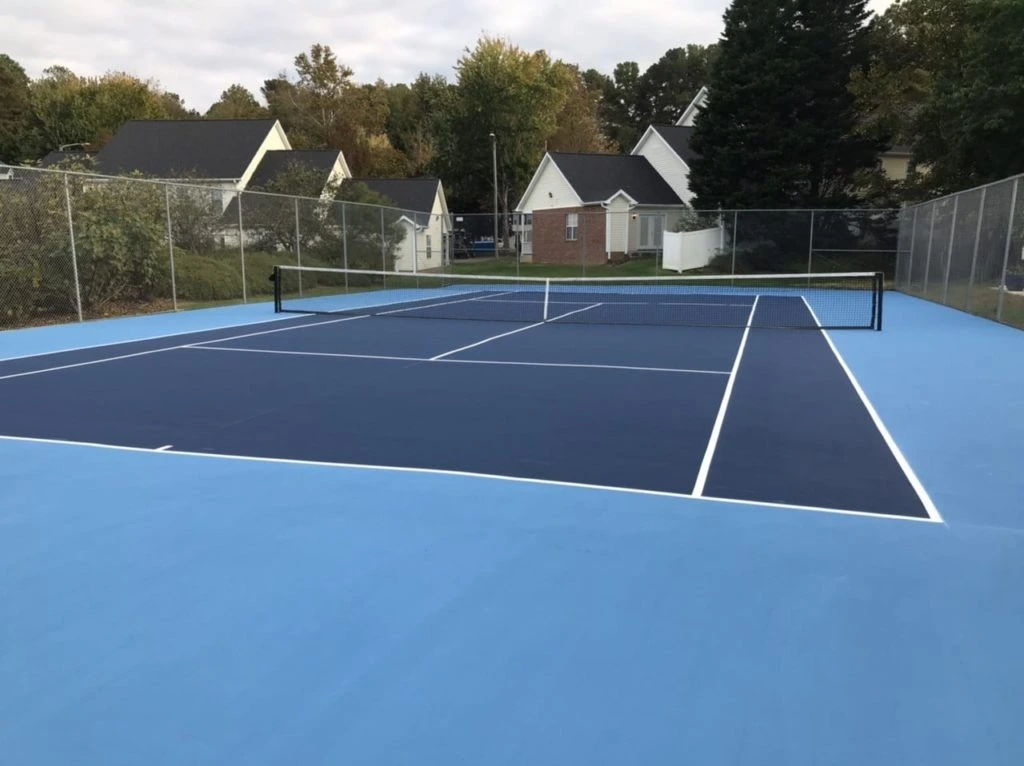
Polypave Court Shield is a crack-prevention and moisture-mitigating system designed for asphalt and concrete sport surfaces. North State Resurfacing, a Raleigh tennis court builder, applies PolyPave to new construction courts and resurfacing projects to control reflective cracking and extend the life of tennis, pickleball, and other courts.
Join our PolyPave Court Shield experts as we cover the product’s core benefits, how the court builders from North State use it for trusted, long lasting crack prevention.
Table of Contents
Benefits of Using Polypave Court Shield for Durable Court Protection
Polypave Court Shield is a patented underlayer that protects your court from the problems that usually come back—cracks and moisture. Think of it like a flexible shield beneath the color coat: it absorbs small shifts in the surface so cracks don’t show through, and it blocks water that can weaken the base during hot, humid summers and cool, wet winters. The payoff is easy to see and feel—smoother bounce, safer footing, fewer repairs, and a court that stays looking new longer.
Let’s take a look at the many benefits this innovation offers to court owners, facility managers, and players across the greater Raleigh area.
How Professional Tennis Court Builders in Raleigh Use Polypave Court Shield
North State Resurfacing is the local contractor Raleigh trusts for tennis court resurfacing and pickleball court resurfacing. The professional court builders use PolyPave Court Shield when long-term durability and consistent play are non-negotiable.
Ideal Conditions for PolyPave Court Shield
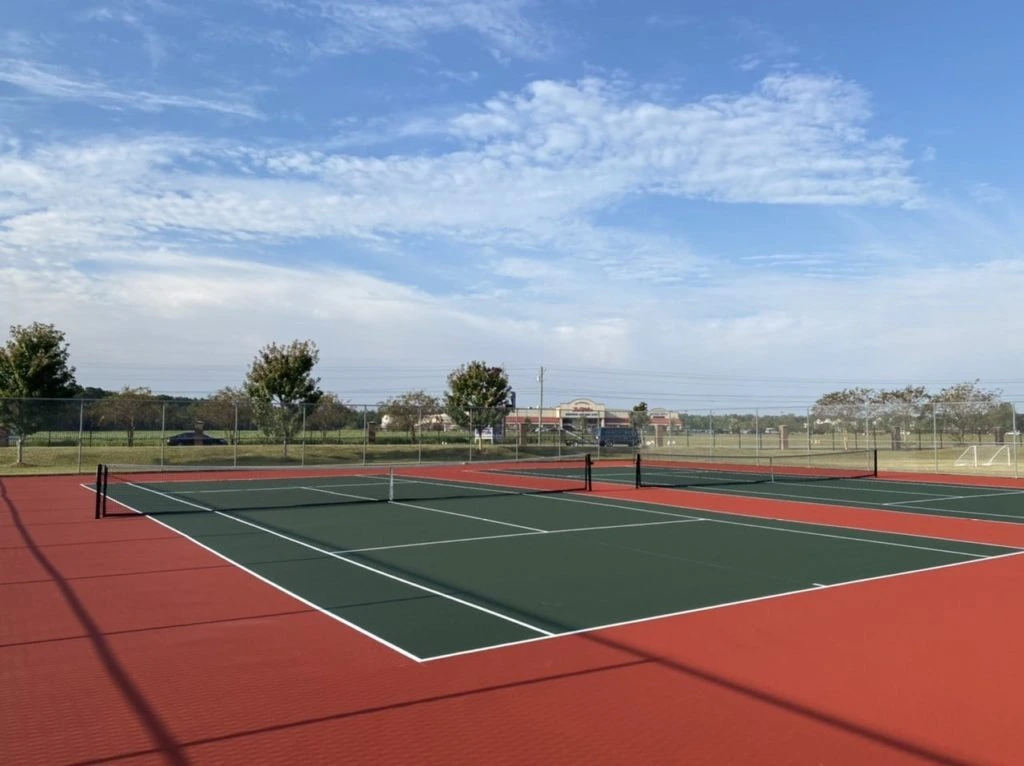
North State recommends PolyPave Court Shield for courts with recurring crack lines, soft or vulnerable bases, or a history of drainage issues. It’s also a smart upgrade on new tennis court construction builds when owners want maximum lifecycle protection from day one. Sites with freeze–thaw swings or expansive soils see the biggest gains in durability and play consistency.
Where PolyPave Delivers The Biggest Wins
High-stress areas—net posts, baseline zones, edges, joints, and prior crack lines—see outsized returns when the PolyPave product is applied by North State’s expert team. Transitions at concrete pads, trench crossings, or utility cuts also stabilize well. The Raleigh court builders can also spot-treat or blanket-apply depending on the court’s condition.
Why PolyPave Beats Patch-Only Repairs
Traditional crack fillers address the symptom, not the underlying movement and moisture issues. The court builders at North State use Polypave Court Shield for a continuous, flexible layer that bridges movement and reduces water pathways. That means fewer callbacks and better playing quality.
How Weather and Scheduling Are Managed
North State Resurfacing watches temperature, humidity, and dew points to hit ideal cure windows when applying the PolyPave product to court surfaces. Staged work areas keep programs running whenever possible, and communication with managers and coaches ensures resurfacing fits league and lesson calendars.
North State Resurfacing’s Process for Crack-Prevention Courts
Every site is different, but North State Resurfacing’s quality controls are consistent. Here’s how they deliver reliable results with Polypave Court Shield.
1. Site Walk, Crack Mapping, and Moisture Readings
North State Resurfacing technicians document structural cracks, birdbaths, joints, and drainage paths, then take moisture readings to identify trapped water. These findings determine whether targeted treatment or full-court coverage will deliver the best long-term outcome.
2. Deep Clean and Surface Prep For Adhesion
The resurfacing team degreases, power-washes, and mechanically prepares the court surface to create a clean, bond-ready profile. Loose edges are trimmed and unstable areas corrected so the membrane adheres uniformly.
3. Route, Fill, and Stabilize Active Cracks
Active cracks are routed, cleaned, and treated with compatible materials to reduce movement at the source. Reinforcement is installed at priority locations to help prevent those lines from telegraphing back through future coatings.
4. Apply Polypave Court Shield: Spot Or Blanket
Based on the assessment, the Raleigh court builders install the membrane in targeted zones or across the entire court. Wet-film thickness, overlaps, and terminations are monitored continuously to ensure consistent coverage.
5. Fortify High-Movement Zones
The North Carolina court resurfacing experts add localized reinforcement around net posts, baselines, perimeter edges, and known failure points. Concentrating PolyPave’s protection in high-stress areas improves durability and play consistency.
6. Controlled Cure and Quality Inspection
Cure schedules are set around temperature, humidity, and dew point to protect performance. After curing, the installation is checked for by North State’s knowledgeable team for continuity, adhesion, and edge detailing before color coats begin.
7. Acrylic Color System and Sport-Specific Texture
A compatible acrylic system is installed, with texture and speed tuned for tennis, pickleball, basketball, or multi-use court requirements. Final striping follows the relevant sport standards for accurate, repeatable play lines.
8. Reopen Protocols and Maintenance Calendar
Facility owners receive reopening guidance from the team at North State—including rolling-load limits—and a simple maintenance plan. Routine cleaning and timely touch-ups help preserve performance and extend intervals between resurfacing cycles.
Types of Courts North State Uses Polypave Court Shield On
The patented, innovative crack prevention system is versatile across outdoor sport surfaces, especially where movement and moisture threaten performance. North State Resurfacing builds and resurfaces a variety of court types that benefit from the extended protective features that PolyPave delivers.
Polypave Court Shield FAQs
Will PolyPave Court Shield eliminate surface cracks forever?
No system can stop all substrate movement, but this patented product significantly reduces crack returns and extends maintenance cycles.
Can PolyPave be used on asphalt and concrete surfaces?
Yes. It’s designed to integrate with both asphalt and concrete courts, provided preparation and detailing are done by a reputable court builder like North State Resurfacing in Raleigh, NC.
How long does PolyPave Court Shield take to install?
Timelines vary by size, weather, and scope, but it typically fits within a standard resurfacing schedule of 5–10 calendar days for a single court and roughly 2–3 weeks for multi-court complexes.
Does the PolyPave product change ball speed or texture?
North State’s experts tune the acrylic layers above the membrane to meet your preferred speed and grit, so play stays consistent.
Is PolyPave Court Shield better than crack filler alone?
For recurring cracks, yes—because PolyPave addresses movement and moisture across a broader area, not just the visible line.
What maintenance is required for PolyPave Court Shield?
Routine cleaning, prompt touch-ups, and periodic color recoats keep performance high and aesthetics sharp.
Is PolyPave a good fit for Raleigh’s climate?
Yes. The system is well-suited for Raleigh’s freeze-thaw swings and seasonal humidity, as proven by the continued use and success of the Raleigh court resurfacing experts from North State who find the product helps protect the court base beneath coatings.
Contact Trusted Raleigh Tennis Court Builders Today
North State Resurfacing designs, builds, and resurfaces tennis, pickleball, basketball, and multi-use courts across Raleigh and the Triangle using Polypave Court Shield for long-term protection. If you’re planning a new court or scheduling maintenance, their experienced team will assess your surface and recommend the right specification for durability, play quality, and budget.
Get started today by calling (252) 955-7439 or filling out their contact form online to schedule a consultation in North Carolina, South Carolina, or Virginia.